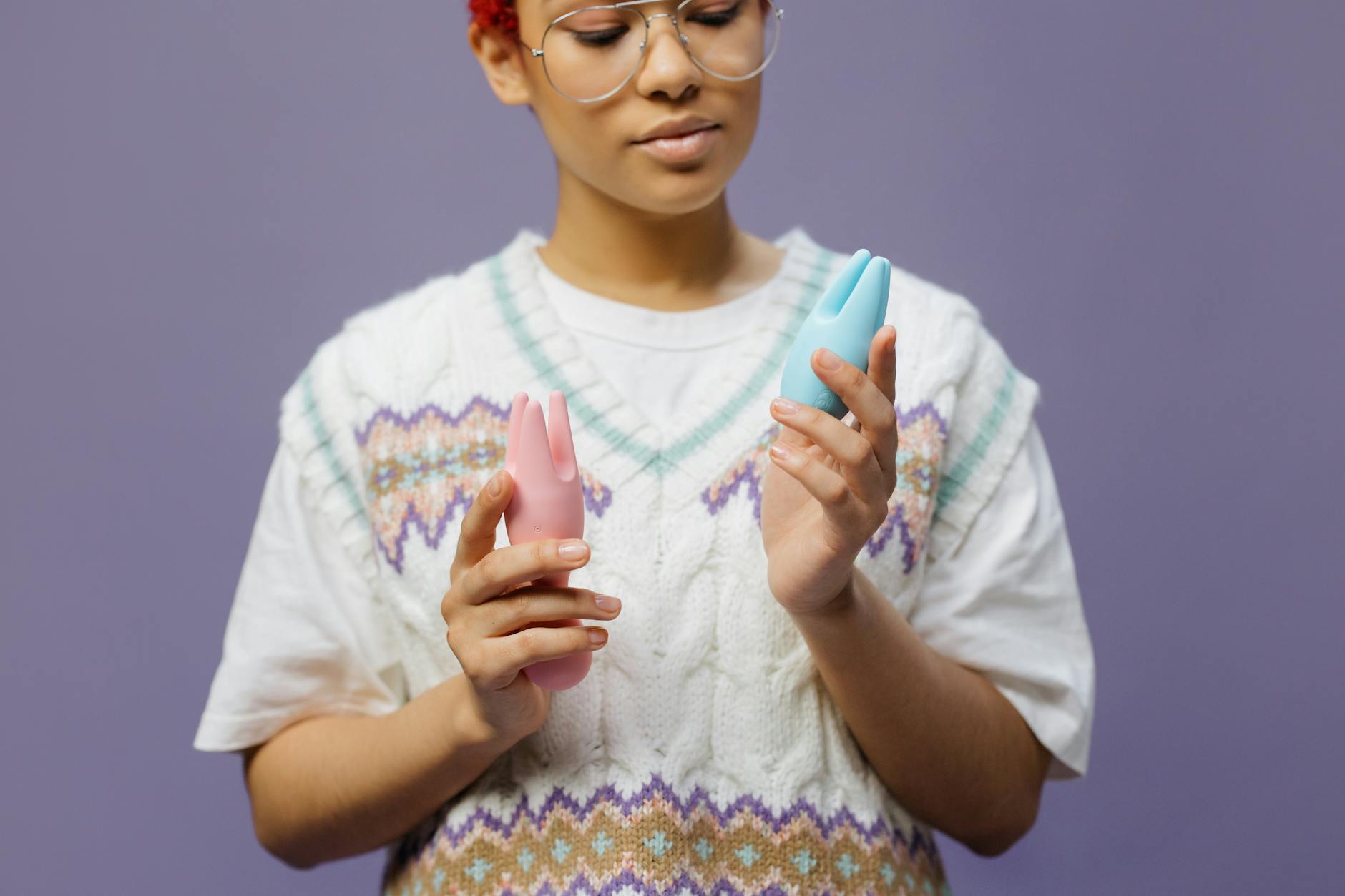
Let's name what's actually happening
Performance anxiety doesn't come from your body. It comes from your brain deciding to narrate your experience instead of living it. You're mid-arousal and suddenly thinking: "Am I taking too long? Does my partner think I'm broken? Is this supposed to feel different?" The moment that thought lands, your nervous system shifts out of parasympathetic (rest and pleasure) into sympathetic (fight or flight). Arousal tanks. Sensation disappears.
This is not a weakness. This is neurobiology.
Why performance anxiety kills pleasure
When you're anxious about whether you'll orgasm or whether your body is "normal," your prefrontal cortex (the thinking brain) floods with cortisol and adrenaline. This is useful when you're running from a predator. It's catastrophic when you're trying to have an orgasm. Your body literally cannot be both in fight-or-flight and in pleasure at the same time. It's a neurological impossibility.
The clitoris is exquisitely sensitive to this switch. Under pressure, blood flow diverts away from genital tissue. Sensitivity drops. Arousal feels flat. Then you panic because nothing is happening, which triggers more cortisol, which makes sensation worse. The spiral begins.
Here's the thing: lemon sexual toys, especially air pulse vibrators like those offered by Lemons Massager, break this spiral in a specific, neurologically useful way.
How lemon vibrators bypass the performance narrative
Air pulse technology works differently than traditional vibration. Instead of buzzing against your clitoris, it creates a gentle suction that stimulates the entire nerve cluster, not just the surface. This distinction matters when anxiety is involved.
When you're using a lemon vibrator, two things happen psychologically:
First, the sensation is novel enough to interrupt rumination. Your brain cannot simultaneously narrate your inadequacy and focus on a completely new sensation. Novelty hijacks attention. This is why people often find that lemon clitoral vibrators work when nothing else does. Your brain has no existing anxiety script for this feeling, so it has to be present with it.
Second, air pulse stimulation feels less like "performing" and more like receiving. Traditional vibration requires you to position yourself correctly, find the right angle, maintain pressure. It's active, controllable, easy to judge. Air pulse is passive. You rest against it, and it does the work. Psychologically, this shift from "doing it right" to "letting this happen" is enormous.
The practical setup that matters
Three things change how lemon adult toys work when anxiety is in the room:
Location and privacy. Performance anxiety thrives on the possibility of interruption. If you're using a lemon vibrator with a partner nearby who might walk in, or you're listening for sounds in the house, your nervous system stays in alert mode. Create actual privacy. Door locked, phone away, time carved out. Tell your partner explicitly: "I need 30 minutes alone." This permission matters more than you'd think.
Start with zero expectation. This is counterintuitive when you're anxious about orgasms, but the moment you set an orgasm as the goal, you've reactivated performance pressure. Instead, approach solo play with lemon vibrators as data gathering. You're learning what sensation feels like when there's zero judgment. You're allowed to enjoy it, stop it, switch settings, rest. No outcome required.
Use a lower setting first. Lemon vibrators have multiple patterns and intensities. When anxiety is present, high intensity can feel overwhelming or intrusive. Start at pattern one or two, low intensity. The goal is to notice sensation, not to chase stimulation. As your nervous system calms, you can increase. You're teaching your body that it's safe to feel.
What to do if anxiety spikes mid-session
If you notice yourself thinking "This isn't working" or "Why is this hard for me," you've caught the anxiety narrative starting. Don't push through it. Instead:
Pause. Breathe fully for 30 seconds. Notice what your body actually feels, not what it should feel. If your clitoris feels numb or distant, that's information, not failure. Your nervous system is protecting you from feeling too much too fast. Thank it. Then gently resume with a lower setting.
Many people find that using lemon clitoral vibrators solo, without any partner pressure, completely rewires their nervous system around pleasure. After three or four sessions of pure sensation with zero outcome pressure, many clients report that partnered sex becomes easier, not because anything changed physically, but because their brain stopped narrating a failure story.
When to bring this into partnered sex
Once you've reconnected with sensation solo, adding a lemon vibrator into partnered play is different. The anxiety script often changes from "I won't be able to come" to "My partner will judge me for needing help." This is real and worth naming directly.
Having a conversation before you integrate a lemon vibrator into partnered sex matters. Try: "I want to use this because it helps me feel more present, not because anything is wrong with me or with us." Most partners are relieved to hear this. It removes the pressure from them to be the sole source of pleasure, which often reduces their own performance anxiety.
Why lemon vibrators work specifically for this
Lemon sexual toys by Lemons Massager are designed with pleasure, not performance, in mind. The air pulse technology means you're not chasing a goal, you're receiving sensation. The range of settings means you can adjust without complexity. The design is intuitive enough that your brain isn't problem-solving. It's just present.
For people with anxiety, this simplicity is everything. You need your nervous system to believe that pleasure doesn't require perfect conditions or perfect execution. Lemon vibrators, with their consistent, gentle suction, teach that belief faster than anything else.
The longer game
Performance anxiety didn't develop overnight. It won't disappear in one session. But here's what many people find: after two or three weeks of regular solo play with lemon clitoral vibrators, using a lower setting and zero expectations, something shifts. The narrative quiets. Your body starts to believe it's safe to feel. Sensation returns. And when you bring that rebuilt confidence into partnered sex, everything changes.
The anxiety didn't disappear. But your body learned that it can experience pleasure without needing to perform. And that's the whole game.
People also ask
How long does it take for performance anxiety to improve with lemon vibrators?
Most people notice a shift in sensation within two to three sessions. Anxiety rarely disappears completely, but the intensity usually drops noticeably within one to two weeks of consistent solo use. The key is consistency, not duration. Three 15-minute sessions per week matters more than one 45-minute session. You're training your nervous system, and nervous systems respond to repetition, not intensity.
Can I use lemon vibrators with a partner if I have performance anxiety?
Yes, but not until you've done solo work first. Solo play teaches your body what pleasure without judgment feels like. Once that knowledge is embedded, adding a partner back in is easier because you already know the sensation is possible. When you use a lemon vibrator with a partner present, frame it as exploring together, not as a problem you're solving. The tone matters neurologically.
Do lemon adult toys make performance anxiety worse if I'm already stressed about them not working?
If you go into using a lemon vibrator expecting it to "fix" you and then judge yourself for needing it, you've just layered more performance pressure on top of the original anxiety. The solution is to detach from outcome. A lemon vibrator is a tool for sensation, not a treatment for broken anatomy. If you find yourself thinking "This should work by now," you're back in the performance narrative. Pause and reset expectations.
What's the difference between lemon vibrators and regular vibrators for anxiety?
The primary difference is psychological. Traditional vibrators require active positioning and continuous pressure. They feel like you're doing something. Air pulse vibrators like lemon clitoral vibrators feel like something is being done to you. Passivity is neurologically useful when anxiety is present because it interrupts the "Am I doing this right?" narrative. Physically, air pulse also stimulates the broader nerve cluster, which many people with anxiety find less intense and more pleasurable.
Is it normal for sensation to feel muted at first with lemon vibrators?
Completely normal. If you've been anxious about pleasure for a while, your nervous system may have downregulated sensation as a protective mechanism. Think of it like a dimmer switch that's been on low for months. Lemon vibrators don't turn the switch to high immediately. They gently, gradually increase it. Over several sessions, sensation returns. This is actually a good sign. Your body is learning it's safe to feel.
Can my partner and I use the same lemon vibrator, or do we each need one?
You can share, but for anxiety work, having your own is psychologically cleaner. Your solo experience should feel separate from partnered experience. Having your own lemon vibrator means that tool belongs to your exploration, not to the relationship dynamic. Once you're comfortable, sharing is fine. But early on, ownership matters.
The bottom line
Performance anxiety is not a character flaw. It's your nervous system doing exactly what it's been trained to do. Lemon clitoral vibrators, with their gentle air pulse technology, offer a neurologically useful way to retrain that system. They bypass the performance narrative, rebuild sensation gradually, and teach your body that pleasure doesn't require perfect conditions or perfect execution.
Start solo. Expect nothing. Use a lower setting. Let sensation return on its own timeline. Reach out to our team if you want personalized guidance on rebuilding intimacy and managing anxiety in your relationship. You deserve to experience pleasure without the constant internal critic narrating your worth.